

Understanding the Energetic Body: A Beginner's Guide
What if the pain you carry isn't just physical, emotional or even psychological —but lives in a field of energy that shapes them all?
This is where energy healing begins. Before we can clear or transform what's blocked, we need to understand what we're working with. The energetic body—also called the subtle body—isn't metaphorical speculation. It's an experiential map that thousands of traditions have independently discovered.
Whether you're new to this terrain or simply looking for clearer language around what you've sensed, this guide will ground you in the fundamentals.
What Is the Energetic Body?
The energetic body refers to the non-physical dimensions that surround, penetrate, and inform our physical form. Think of it as the software running the hardware—except "software" suggests something artificial. This is more fundamental: the energetic body is you, just at a different frequency.
Different traditions use different terminology, but most recognise a layered structure. The image above illustrates this beautifully: each plane vibrates at a distinct frequency, with lower densities anchoring into the earth and higher frequencies extending toward pure consciousness.
Here are the commonly referenced fields, in their typical ordering from the most dense to the most subtle:
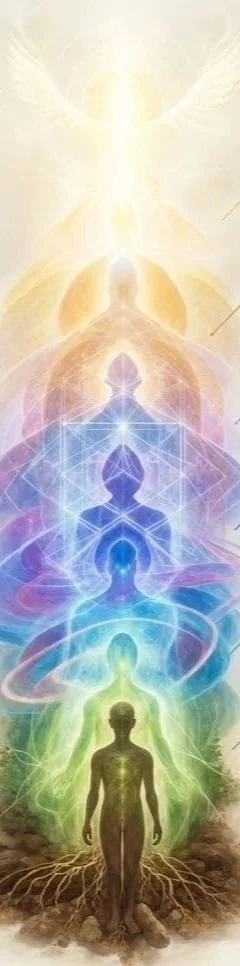
Physical Body (Incarnate Plane)
The densest layer—what you can touch, measure, and observe scientifically. Illness, injury, and trauma register here first, though their origins may stem from higher planes.
Etheric Body (Vital Plane)
The layer closest to the physical, often described as the blueprint for the physical form. This carries vitality, life force, and the templates through which the physical body expresses. When you feel physically drained or exhausted without apparent cause, this layer is often involved.
Astral Body (Emotional Plane)
The realm of emotions, desires, and feelings. This is where you experience joy, grief, anger, and love in their pure energetic form. When you feel "emotionally charged" after an encounter, the astral body is responding.
Mental Body
The realm of thought, belief systems, and cognitive patterns. This isn't just conscious thinking—it includes subconscious programs, mental conditioning, and the structures through which you interpret reality.
Upper Mental (Higher Mental / Intuitive Plane)
Beyond ordinary cognition lies intuitive knowing. This is where insights arise without logical derivation, where synthesis replaces analysis. Many spiritual traditions refer to this as the seat of wisdom.
Causal Body (Spiritual Plane)
The deepest individual soul layer—beyond personality, beyond lifetime. This is the essence of who you are apart from temporal reality.
Some models include planes beyond individual consciousness entirely—pure awareness without subject-object duality. There are also chakras above the crown and below the root that connect to these higher and grounding planes. These aren't always mapped in beginner texts, but they exist and activate as your awareness deepens.
Important to note: These planes aren't separate compartments. They overlap and permeate one another. A disturbance in the mental layer will eventually manifest in the astral—and if unaddressed, may crystallise as physical symptoms.
Energy Centres Across Traditions
Chakras—meaning "wheels" in Sanskrit—are primary vortexes where energy enters and exits the system. Most yogic models describe seven main chakras aligned along the central channel of the spine. However, the specific number, location, and function vary significantly across cultures.
Hindu/Yogic Tradition (Classical Model)
The Hindu tradition identifies seven primary chakras from root to crown, each associated with specific emotional, psychological, and spiritual functions. There are also subsidiary chakras above and below this main system. Root corresponds to survival and grounding, sacral to creativity and emotion, solar plexus to will and identity, heart to love and compassion, throat to truth and expression, third eye to intuition and insight, and crown to spirituality and connection to source.
Taoist/East Asian Tradition
Taoism describes similar energy centres but uses different terminology and organisation. The lower dan tian sits below the navel (roughly equivalent to sacral/root chakras) as the seat of vital essence. The middle dan tian at the heart centre governs emotional and spiritual refinement. The upper dan tian between the eyebrows houses spirit and consciousness.
Western Esoteric Traditions
Western mystical systems (Hermetic, Kabbalistic, Rosicrucian, Alchemical) adapted energy concepts through their own philosophical lenses. Some Western models describe twelve centres including those at the palms and soles. Others integrate astrological correspondences—each centre aligning with one of the seven classical planets (Moon, Mercury, Venus, Sun, Mars, Jupiter, Saturn), metals, and elements in alchemical tradition. This creates a rich symbolic framework connecting inner anatomy to cosmic patterns. This is certainly worth exploring further.
Important Observation: These maps appear different on the surface, but with practice you begin to see and feel their interconnectedness. They're tools for orientation, not competing truths. Your own energetic anatomy may differ subtly from any traditional model. The best guide is your direct experience—noticing where you feel expansion, constriction, warmth, tingling, or flow during practice.
Energy Circulation: How Energy Moves Through the System
While chakras mark stationary energy centres, circulation refers to how energy flows through the system. Again, different traditions describe this differently. I'll focus on three main models that I work with: Hindu nadis, Western caduceus symbolism, and Taoist microcosmic orbit.
Hindu/Yogic Tradition: The Nadis System
In Hindu yogic tradition, energy flows through hundreds of channels called nadis. Three dominate all others:
Ida nadi flows through the left side and is associated with lunar energy—feminine, receptive, cooling qualities governing introspection, intuition, and emotional processing.
Pingala nadi flows through the right side and is associated with solar energy—masculine, active, heating qualities governing action, logic, and external engagement.
Sushumna runs along the spinal column as the neutral conduit for higher states of consciousness. It opens when ida and pingala are balanced. This is the pathway for kundalini ascension in yogic practice.
When ida and pingala are harmonised, energy rises through sushumna—this is considered a sign of maturation in yogic practice. Imbalances show up as predictable patterns: excessive ida manifests as over-introspection or emotional sluggishness, while excessive pingala shows as overactivity, burnout, or disconnection from inner life.
Western Esoteric Tradition: The Caduceus
The caduceus of Hermes—with two serpents entwined around a central staff—mirrors the Hindu concept of ida and pingala nadis weaving around the sushumna channel. Though this symbol predates its medical association, its esoteric meaning points to the same energetic dynamic: dual currents balancing around a central axis of consciousness.
Taoist Tradition: The Microcosmic Orbit
Taoist practices emphasise the microcosmic orbit—energy circulating up the spine and down the front of the body in a continuous loop. This differs from the vertical ascent emphasised in yoga, instead creating a closed circuit that circulates vital energy through the dan tians and major gates along the path.
I'll be writing a dedicated article on the microcosmic orbit soon, exploring this circulation system in depth.
These Systems Are Complementary: You might say the nadis/caduceus describe lateral balance (left-right integration), while the microcosmic orbit describes anterior-posterior circulation (front-back flow). Both work with the vertical axis, but through different emphases. They're not mutually exclusive—many practitioners work with both simultaneously once their awareness develops sufficiently.
How Working with Psyche Impacts Energy Layers
Here's what makes transpersonal and energy-based work so powerful: working on one layer affects all others.
When you process psychological trauma in therapy, you're not only changing neural pathways—you're releasing stored tension in the etheric layer, shifting belief structures in the mental plane, and potentially clearing ancestral imprints and inherited trauma in the astral body.
Conversely, when you clear blockages in the energy body (through breathwork, hands-on healing, or somatic practices), you often unlock psychological material that was previously inaccessible. Something you couldn't reach in years of talk therapy may dissolve in minutes of targeted energy work.
This bidirectional relationship is why my practice integrates both approaches. Psychological work builds the container; energy work fills and transforms what's inside. Neither alone achieves what both together accomplish.
The unfolding of your awareness is fundamentally a path of evolving consciousness. Psychological examination and awareness are essential components of this journey. You cannot bypass the shadow, the wounds, or the complexed ego-patterns and still arrive at integration. The psyche must be tended alongside the energy body—they're two languages describing the same terrain.
Working With Your Energy Body: Entry Points for Awareness
These foundational practices are accessible to anyone and serve as entry points to commence your awareness of the subtle fields. They're not exhaustive—simply stepping stones toward deeper familiarity.
Grounding
Is all about anchoring diffuse sporadic energy into a more stable form. Walk barefoot on the earth. Visualise roots extending from your feet into the ground. Spend time in nature. Eat hearty nutritious seasonal meals. Physical contact with the earth and nature steady the nervous system and allow the body a much needed rest.
Boundary Awareness
Protects against energetic drain. Imagine a protective sphere of light surrounding your body, with each inhalation channel divine energy from above into your heart centre and further into your energy body. Let this fill your field until you feel protected and held by this energy. Notice when you feel energetically porous—exposed, drained, scattered—these signal weak boundaries that need strengthening. Your awareness here is key as it signals consciousness around certain aspects of your day to day life that do not serve you.
Conscious Breathing
Activates the etheric layer immediately. Try inhaling through your nose for four counts, holding for four, exhaling for six (also through the nose). Repeat for five minutes. The rhythm alone shifts your state of awareness.
Body Scanning
Reveals where energy moves or constricts. Lie down and systematically attend to each body region from toes to crown. Notice where you feel sensations: tension, warmth, numbness, tingling. Simply observing often releases blockages. Releasing blockages leads to greater insight and also deep relaxation.
Prayer
Invite assistance from beyond the individual self. Ask for guidance from above, from your higher self, from sacred sources you trust. Call in the assistance and the sacred energy that supports your life. This isn't necessarily a dependency but rather a relationship that is cultivated over time.
Where This Leads
Understanding the energetic body gives you language for experiences you may already sense. It provides a framework for distinguishing between different kinds of distress, different modes of healing, and different paths forward.
But knowledge alone isn't enough. The energetic body responds to direct experience—not intellectual comprehension. As you continue exploring, notice what resonates. Notice what doesn't. Trust your own system as the ultimate authority.
The unfolding of your awareness is a journey of evolving consciousness. Along this path, psychological work and energetic work act as companions in an ever-unfolding mystery. Together, they enable the kind of transformation that reshapes not just how you feel, but who you are able to become.